

Master Sergeant Turner Grady Blount
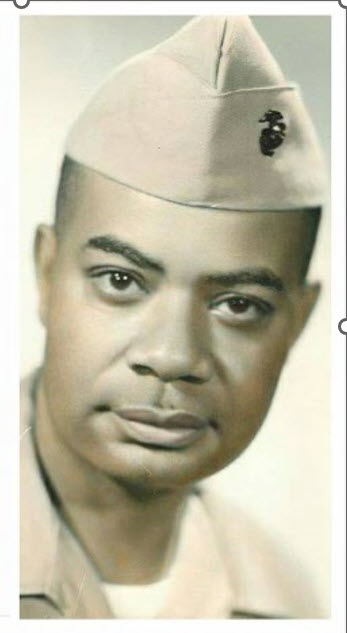
- Unit: 7th Field Depot, 19th Marine Depot Company
- Date of Birth: June 30, 1925
- Entered the Military: November 4, 1943
- Date of Death: July 21, 2017
- Hometown: Keysville, Georgia
- Place of Death: Jacksonville, North Carolina
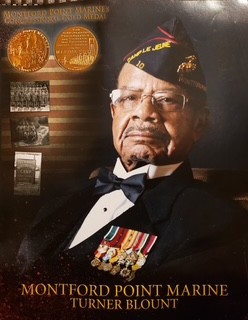
- Award(s): Congressional Gold Medal, Navy and Marine Corps Commendation Medal, the Good Conduct Medal with 5 stars, National Defense Service Medal with 1 star, Vietnamese Service Medal, Vietnamese Campaign Medal with 2 stars, Marksmanship Pistol Badge
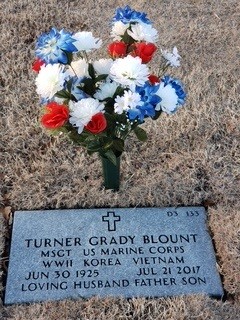
- Cemetery: Section D3, Grave 133. Coastal Carolina State Veterans Cemetery, Jacksonville, North Carolina
Mentored by Ms. Patricia Robblee
Lejeune High School, Camp Lejeune, North Carolina
2025/2026
Early Life
Turner Grady Blount was born to Baltimore and Perrilla Blount on June 30, 1925. He and his 12 siblings grew up in Keysville, Georgia. Keysville was a very small, rural town where agriculture was the primary occupation.
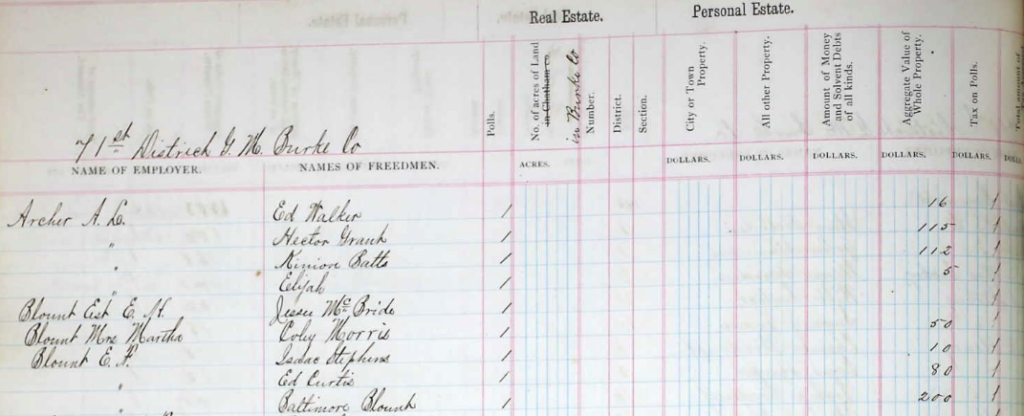
Blount’s grandparents were among the first generation freed from slavery. His paternal grandfather, also named Baltimore Blount, is listed in the Burke County property tax digests for 1874 to 1876, in militia district 71, as a freedman employed by E.F. Blount. The digest indicates he had property valued at $200 and owed $1 for poll tax.
Blount’s parents, born in the 1880s, both attended school, his father until grade five, and his mother until grade eight. His father worked as a chauffeur, and his mother was a homemaker.
Blount’s military career began before he graduated from high school. Drafted into the military for World War II, he ambitiously chose to enlist in the Marine Corps because he heard it was the “strongest” branch.

Homefront
Keysville was and still is primarily a rural, agricultural community. According to census records, the population of Keysville was fewer than 400 people when Blount was growing up. The Great Depression led to the dissolution of the local government in 1933. Keysville remained unincorporated until 1990.
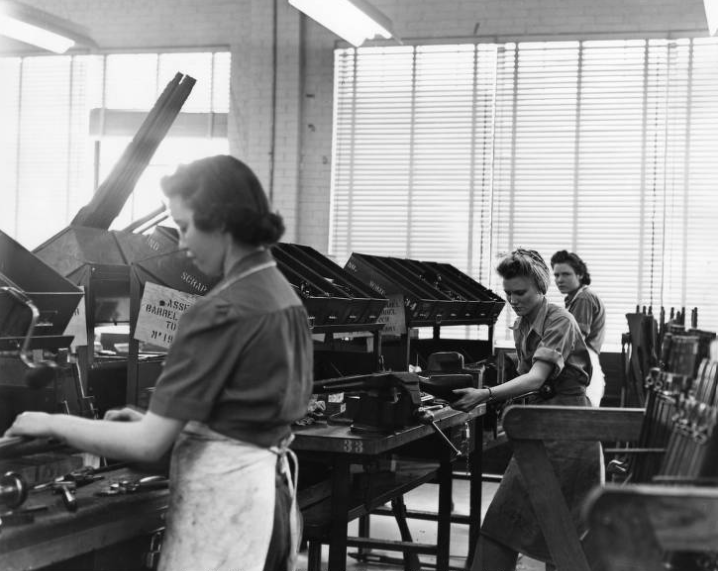
As war raged in Europe, the United States began transforming its industrial complex to prepare for war. The government acquired land to build military bases for training troops. Businesses refitted their factories to change from building cars to building tanks and other armaments. World War II shifted Georgia’s economy from agriculture to industry.
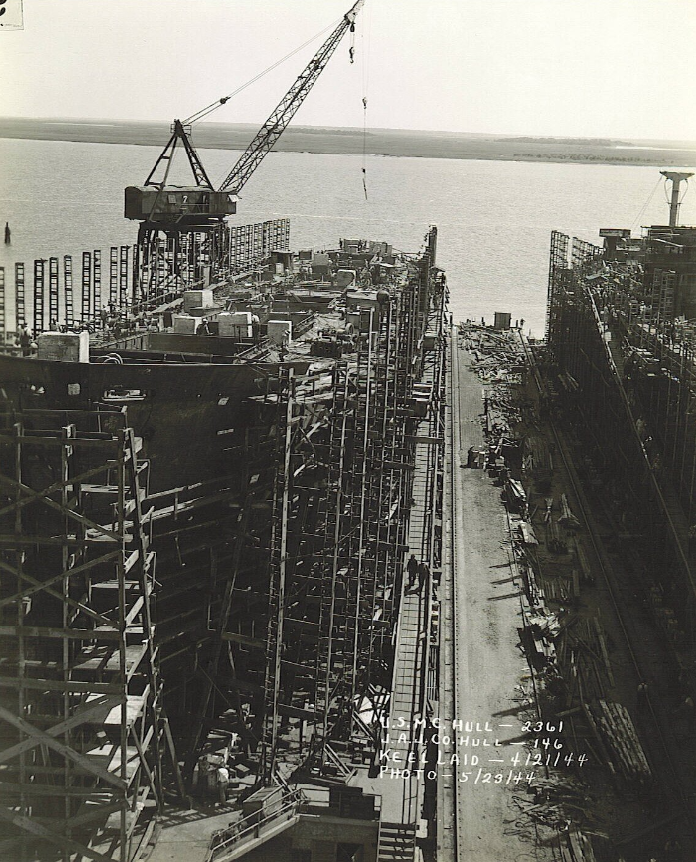
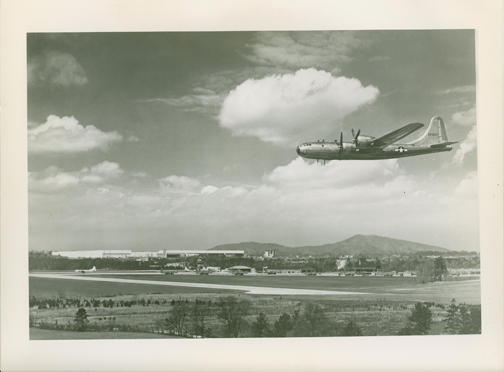
Georgia mobilized to assist in the war effort. Residents of Keysville hosted events to support troops. They participated in scrap metal drives and victory gardens. Farmers increased their crop and livestock production. Others commuted or moved to work in one of the many war industries within a couple of hours of town. Bell Aircraft built B-29 Bombers in Marietta. Macon and Milledgeville had ordinance plants. Two Liberty shipyards were opened in Savannah and Brunswick, which constructed 200 Liberty ships to transport troops overseas. They mastered the process so well that they could complete a ship in 89 days.
Construction on Camp Gordon near Augusta, Georgia, began in July 1941. In addition to housing the 4th Infantry, 26th Infantry, and 10th Armored Divisions, it served as a camp for German and Italian Prisoners of War (POWs) from October 1943 to January 1945. The POWs assisted as farm labor where shortages existed.
The efforts put forth by Georgian residents assisted in bringing them out of the depression. By war’s end, every major city in Georgia had a key military installation that was integral to the war effort.

Military Experience
Executive Order 8802
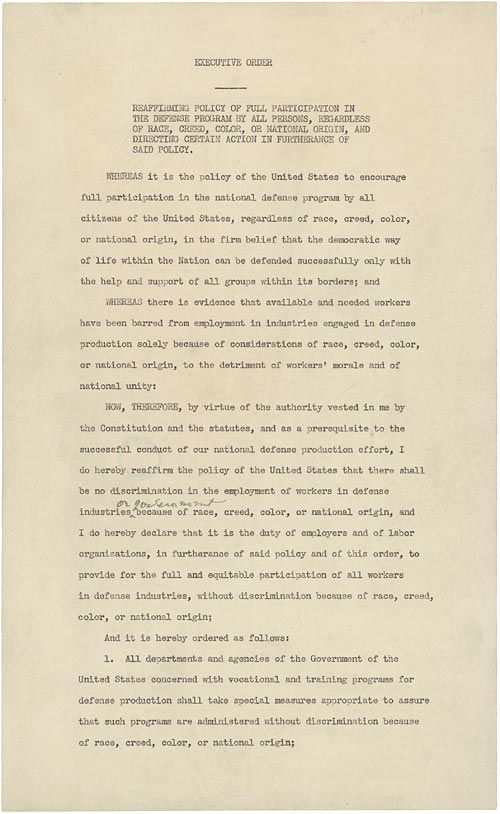
Under pressure from Black leaders and his wife, Eleanor, President Franklin D. Roosevelt issued Executive Order 8802 on June 25, 1941, which prohibited discrimination in the defense industry. The Marine Corps was the last branch to open its doors to African Americans, due to opposition from senior leadership, in 1942.
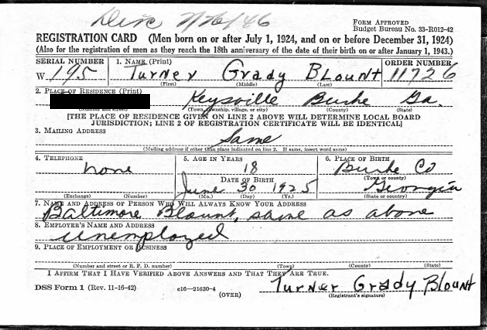
Blount registered for the draft on June 30, 1943, the day he turned 18. He was inducted into the Marine Corps on October 19 with 155 other Black recruits.
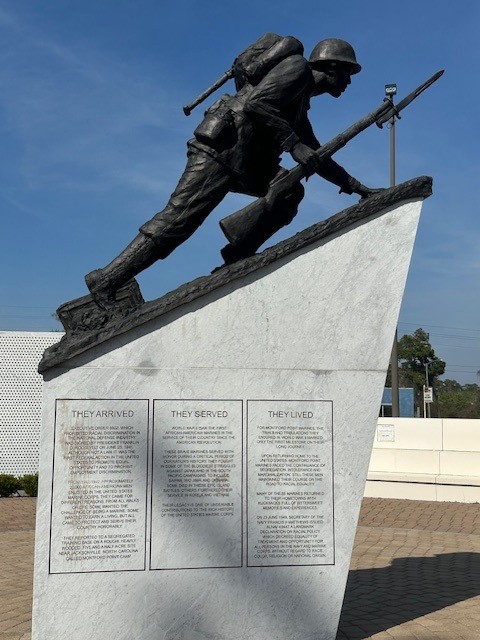
Montford Point
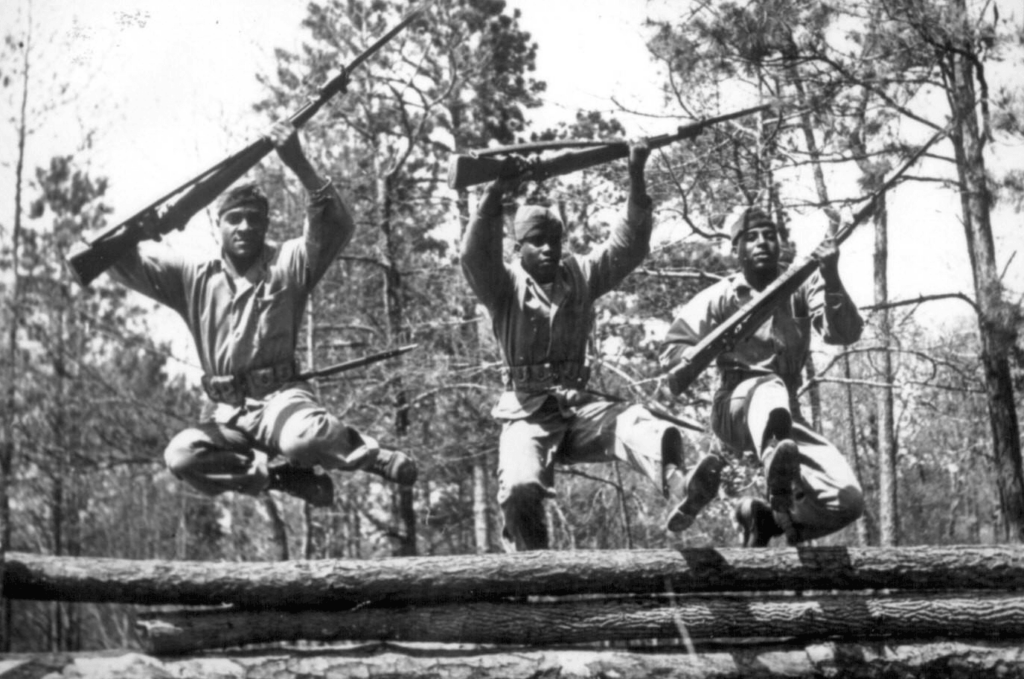
Blount was sent to Montford Point, the base created near Camp Lejeune to train Black recruits. As a Montford Point Marine, he faced many unique challenges and had to overcome significant adversity. Although basic training for any Marine is extremely difficult, Marines at Montford Point faced challenges their White counterparts could not imagine.
Early Montford Pointers arrived at the training camp to see undeveloped woodlands. They slept in tents and, in addition to their normal rigorous training, were responsible for building all the structures required for training.
After the early classes of Montford Point Marines graduated, some were selected to train recruits there. Recruits at the base hoped these drill instructors would be more accepting; however, African American drill instructors were often harder on the recruits there than the White drill instructors had been. They were pushed harder than their White counterparts. Excellence was the only option. Graduates from Montford Point would go on to be some of the most competent and capable Marines in the Corps.
Pacific Theater of Operations
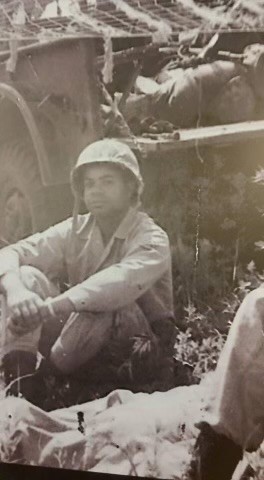
In World War II, Blount served in the Pacific Theater on the islands of Saipan, Tinian, and Okinawa. The Battle of Saipan took place from June 15 to July 9, 1944. African American troops were responsible for moving supplies, guarding prisoners, and providing security. Blount was a part of the 19th Depot, assisting the 2nd Marine Division.
The 19th Depot moved supplies inland under sniper fire and brought back casualties from the front lines. They lived in foxholes instead of tents. One of Blount’s first tasks was helping a chaplain collect dog tags from dead soldiers. He later recalled that it was one of the toughest experiences of his military career.
With the contribution of the Montford Pointers, the Battle of Saipan was the first major American victory in an area controlled by Japan. Blount and the Montford Point Marines’ successes helped them earn respect from some of their White counterparts and justified the Marine Corps’s ultimate desegregation. Their work on Saipan and Tinian earned them the Presidential Unit Citation.
After the war, Blount returned to Keysville to continue his high school education. He graduated and joined the Marine Corps Reserves, and was later recalled to active duty to serve in the Korean War. He deployed to Japan, where his job was Motor Transport.
Korean War
On July 26, 1948, the military was desegregated when President Harry Truman issued Executive Order 9981. The order required all branches of the military to provide equal opportunity and treatment regardless of race, color, religion, or national origin. However, many military installations were located in areas still plagued by discrimination and segregation. In these cases, Black military personnel were not able to interact much with off-base communities. This is something that Blount experienced while stationed on Camp Lejeune after the Korean War.
Vietnam War
When the Vietnam War began, Blount deployed once again, this time serving as security for a helicopter squadron at Da Nang Air Base. He remained in the Marine Corps until 1969, retiring as a master sergeant.
Veteran Experience
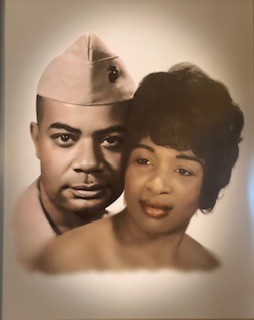
Master Sergeant Blount was discharged from the Marine Corps on September 30, 1969, at Camp Lejeune, North Carolina. Between the Korean and Vietnam Wars, Blount met his spouse, Sadie Mae Parker, while stationed at Marine Corps Base Camp Lejeune. They married on December 20, 1955. They would go on to have nine children and live in Jacksonville, North Carolina.
Blount continued to serve Jacksonville and the Marine Corps after he retired. He mentored young Marines and was known as “Daddy Blount” by those who frequently visited him. His home was a place where Marines without a place to stay or who missed home could find comfort. He was an active member of the Sandy Run Missionary Baptist Church community and managed the church-owned apartments for low-income individuals.
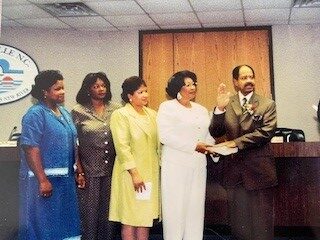
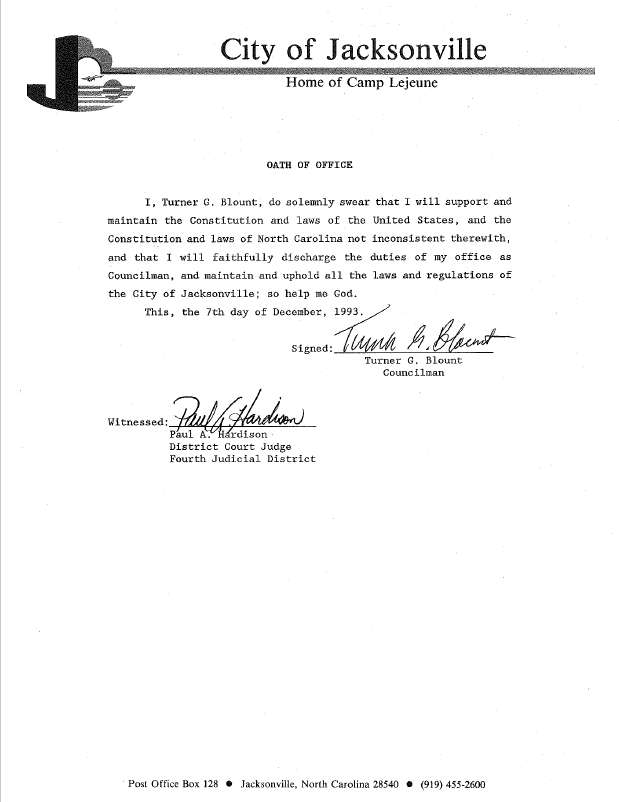
In 1993, he began a new chapter of service as an elected member of the Jacksonville City Council. He served on the Jacksonville City Council from 1993 to 1998 and from 2002 to 2007. He left a lasting impact on the community by contributing to legislation that named the Jacksonville bypass after Dr. Martin Luther King, Jr. He was also appointed by County Commissioners to the Social Services Board, which provides protective services, food and nutrition, and medical care for children, the disabled, and the elderly.
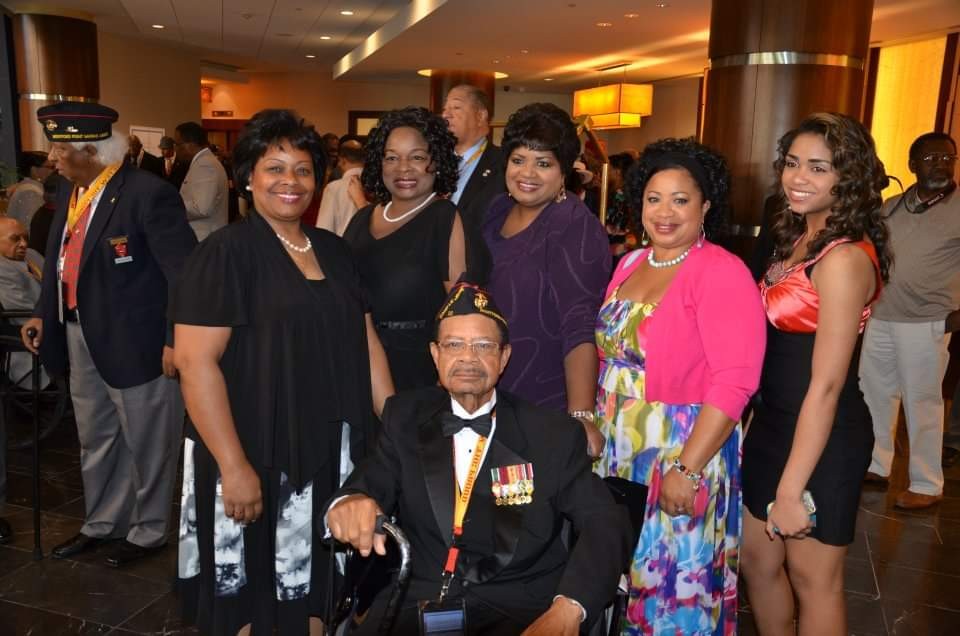
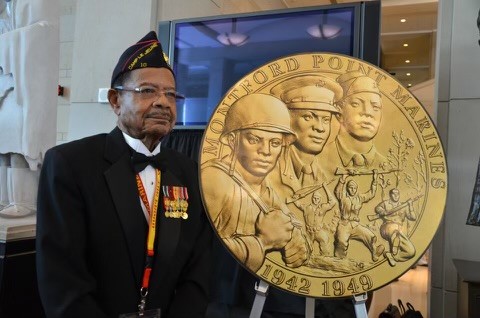
In time for the Marine Corps Birthday in 2011, Congress passed a law granting the Montford Point Marines the Congressional Gold Medal, the highest civilian award. Master Sergeant Blount was on hand to receive his Congressional Gold Medal from President Barack Obama in June 2012.
Master Sergeant Blount experienced great change from his first steps at Montford Point in 1943 to his last in Jacksonville in 2017—from a segregated community, where he could not cross the railroad tracks leaving base, to an integrated community, with the opportunity to serve as an elected official working for continued change and improvement.
Commemoration
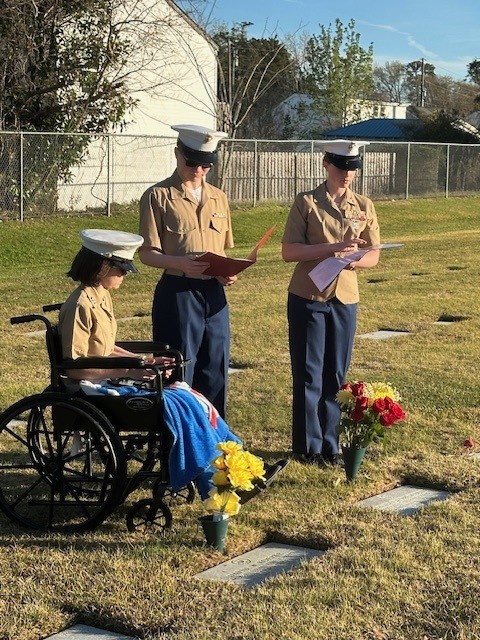
Master Sergeant Turner Grady Blount passed away on July 21, 2017, at the age of 92. He is buried at the Coastal Carolina State Veterans Cemetery in Jacksonville, North Carolina.
Blount will be remembered not only for his military service across three wars but also for mentoring young Marines who followed in his footsteps and for his civic contributions to the Jacksonville community.
Bibliography
Primary Sources
“156 Colored Draftees To Be Inducted, Oct. 19.” The True Citizen [Waynseboro, GA], Oct. 14, 1943. Georgia Historic Newspapers, https://gahistoricnewspapers.galileo.usg.edu/lccn/sn89053289/1943-10-14/ed-1/seq-6/#words=Blount+Turner.
B-29 in flight over Marietta. Photograph. c.1943-1945. Bell Aircraft Georgia Division (Marietta) Collection, 1942-1945, SC/B/001, Kennesaw State University Archives (B-04-013). https://soar.kennesaw.edu/entities/publication/2e66f84c-102e-4c51-aa53-622e8568b665.
Baltimore Blount. Georgia, U.S., Property Tax Digests, 1793-1892. Digital images. https://ancestry.com.
Blount Family Records, 1943-2017. Courtesy of the Montford Point Museum.
Blount, Watson. “Items of Interest to Colored People.” The True Citizen [Waynesboro, GA], March 19, 1942. https://gahistoricnewspapers.galileo.usg.edu/lccn/sn89053289/1942-03-19/ed-1/seq-6/.
Garcia, Dorothy. Interview with the authors. December 17, 2025.
Georgia. Burke County. 1880 U.S. Census. Digital images. http://ancestry.com.
Georgia. Burke County. 1900 U.S. Census. Digital images. http://ancestry.com.
Georgia. Burke County. 1930 U.S. Census. Digital images. http://ancestry.com.
Georgia. Burke County. 1950 U.S. Census. Digital images. http://ancestry.com.
“Keysville Soldier in Iwo Jima Operation.” The True Citizen [Waynesboro, GA], April 8, 1954. Georgia Historic Newspapers. https://gahistoricnewspapers.galileo.usg.edu/lccn/sn89053289/1954-04-08/ed-1/seq-1/#words=Blount+Turner.
[Photograph of the Liberty ship Augustine B. McManus under construction, J.A. Jones Construction Company shipyard, Brunswick, Georgia]. Photograph. May 24, 1944. Digital Library of Georgia. https://dlg.usg.edu/record/dlg_vsbg_jaj014#item.
Sixteenth Census of the United States: 1940 Agriculture Vol 1 First and Second Series State Reports Part 3 Statistics for Counties. U.S. Department of Commerce. Government Printing Office, 1942. https://www2.census.gov/library/publications/decennial/1940/agriculture/1940-census-agriculture-vol-1-georgia.pdf.
Trail, Amy. “A True Legacy: Montford Point Marine Shares Life-Changing Experiences.” Marine Corps Air Station Cherry Point. February 19, 2010. https://www.cherrypoint.marines.mil/News/Article/524728/a-true-legacy-montford-point-marine-shares-life-changing-experiences/.
“Turner Blount.” Jacksonville Daily News [Jacksonville, North Carolina], July 22, 2017. https://www.legacy.com/us/obituaries/jdnews/name/turner-blount-obituary?id=40223855.
Turner Blount. Oral History. July 21, 2005. Courtesy of the Montford Point Museum.
Turner G. Blount. North Carolina, U.S., County Marriage Records, 1741-2011. Digital images. https://ancestry.com.
Turner Grady Blount. U.S. Department of Veterans Affairs BIRLS Death File, 1850-2020. Digital images. https://ancestry.com.
Turner Grady Blount. U.S. Marine Corps Muster Rolls 1798-1958. https://ancestry.com.
Turner Grady Blount. World War II Draft Cards Young Men, 1940-1947. Digital images. https://ancestry.com.
U.S. Marines jump over an obstacle during basic training at Camp Montford Point, N.C. The Marines who visited Langley Air Force Base, Va., July 2, 2013, trained under well-known drill instructors like Sgt. Majs. Gilbert “Hashmark” Johnson and Edgar Huff, and provide a unique insight into a pivotal moment in military history. Photograph. U.S. Marine Corps. https://www.acc.af.mil/News/Photos/igphoto/2000034232/.
“A Week of War.” The True Citizen [Waynesboro, GA], March 19, 1942. https://gahistoricnewspapers.galileo.usg.edu/lccn/sn89053289/1942-03-19/ed-1/seq-6/.
Women at the Augusta Arsenal assemble weapons for World War II troops, 1943. Photograph. 1943. Atlanta Journal-Constitution. Atlanta Journal-Constitution Photographic Archives, Georgia State University Library (AJCP455-016j). http://digitalcollections.library.gsu.edu/cdm/ref/collection/ajc/id/11670.
Secondary Sources
Adkins, Matthew. “Montford Point Marines Receive Congressional Gold Medal.” New Bern Sun Journal [New Bern, NC], March 23, 2013. https://www.newbernsj.com/news/local/montford-point-marines-receive-congressional-gold-medal/article_d21d3f28-1fdb-5368-9c0e-70ebadab8210.html.
“Agriculture in Burke County.” Burke County Chamber of Commerce. Last modified 2021. Accessed November 14, 2025. https://burkechamber.org/small-business.php.
“Annual Report FY 2021-2022.” Onslow County Department of Social Services. Accessed January 19, 2026. https://www.onslowcountync.gov/DocumentCenter/View/18452/DSS-Annual-Report-FY21-22.
Brennan, Thomas. “Montford Pointer Recalls’ Hard Core’ Career.” The Daily News [Jacksonville, NC], April 30, 2013. https://www.jdnews.com/news/montford-pointer-recalls-hard-core-career/article_a4be7213-6fcb-5328-9c2c-7efc800494dc.html.
“Battle of Saipan.” HISTORY. Last modified May 28, 2025. Accessed January 15, 2026. https://www.history.com/articles/battle-of-saipan.
Bulszewicz, Anna, and Boyd, Jason. “Former Jacksonville City Council Member and Montford Point Marine Dies.” WCTI12.com. Accessed October 1, 2025. https://wcti12.com/news/local/former-jacksonville-city-council-member-and-montford-point-marine-dies.
“Former Jacksonville City Councilman Passes Away.” WITN, July 21, 2017. https://www.witn.com/content/news/Former-Jacksonville-city-councilman-passes-away-435832923.html.
Hatfield, Edward. “World War II in Georgia.” New Georgia Encyclopedia. Updated July 15, 2020. Accessed November 14, 2025. https://www.georgiaencyclopedia.org/articles/history-archaeology/world-war-ii-in-georgia/.
Hinmon, Derrick. “Keysville boundary feud finally resolved.” The Atlanta Constitution [Atlanta, GA], September 26, 1990. Newspapers.com (138165174).
“Keysville, GA.” Keysville Government. Accessed November 13, 2025. http://keysvillega.org/.
Lutz, Stephen D., “The Few, the Proud, the Black Marines in World War II.” World War II Quarterly Journal of the Second World War Winter 2019: 78-88. https://warfarehistorynetwork.com/article/the-few-the-proud-the-black-marines-in-world-war-ii/.
The Marines of Montford Point Fighting for Freedom. UNCW, 2007.
“Montford Point Marines.” Jacksonville Tourism. Accessed March 5, 2026. https://visitjacksonvillenc.com/176/The-Montford-Point-Marine-Story.
Nalty, Bernard C. Right to Fight: African-American Marines in WWII. Orison Publishers, 1995.
“Perilla Cheatam Blount.” Find a Grave. Accessed October 20, 2025. https://www.findagrave.com/memorial/134627439.
“Reeves History Page.” Karen Reeves. Accessed November 14, 2025. https://reeveshistorypage.weebly.com/library-of-congress-veterans-project.html.
Trail, Amy. “A True Legacy: Montford Point Marine Shares Life-Changing Experiences.” Marine Corps Air Station Cherry Point. Accessed September 20, 2025. https://www.cherrypoint.marines.mil/News/Article/524728/a-true-legacy-montford-point-marine-shares-life-changing-experiences/.
Treadwell, David. “Georgia Whites Resist Blacks’ Efforts to Set Up City Service.” The Los Angeles Times [Los Angeles, CA], March 15, 1987. https://www.latimes.com/archives/la-xpm-1987-03-15-mn-10941-story.html#
“Turner Grady Blount.” Find a Grave. Accessed April 19, 2026. https://www.findagrave.com/memorial/201994208/turner-grady-blount.
“Turner Grady Blount.” Veterans Legacy Memorial, National Cemetery Administration. Accessed April 19, 2026. https://www.vlm.cem.va.gov/TURNERGRADYBLOUNT/466A75.
Watson, Alan D. Onslow County: A Brief History. Raleigh: North Carolina Division of Archives and History, 1995.
“World War II and Georgia – Today in Georgia History, December 31, 1946.” Today in Georgia History. Accessed November 13, 2025. https://www.todayingeorgiahistory.org/tih-georgia-day/world-war-ii-and-georgia.
This profile was funded by a grant from the United States Department of Veterans Affairs. The opinions, findings, and conclusions stated herein are those of the author and do not necessarily reflect those of the United States Department of Veterans Affairs.