
Private First Class William Arthur “Speedy” Hecht
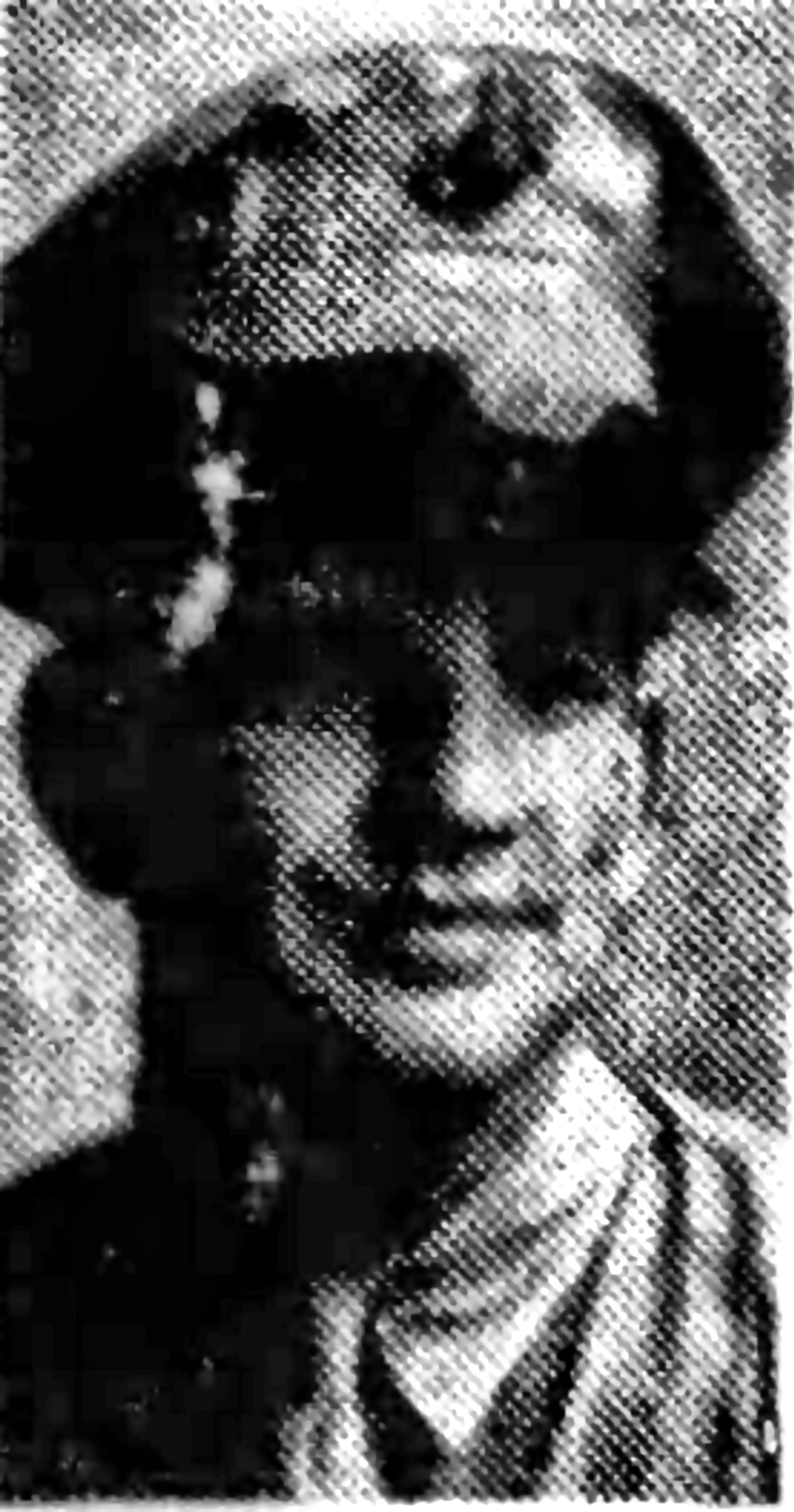
- Unit: 22nd Marine Regiment, 1st Battalion, Company B
- Date of Birth: December 21, 1920
- Entered the Military: April 9, 1942
- Date of Death: May 2, 2012
- Hometown: Springfield, Ohio
- Place of Death: Keller, Texas
- Award(s): Purple Heart, Combat Action Ribbon, Navy Unit Commendation, American Campaign Medal, Asiatic Pacific Campaign Medal with one bronze campaign star, World War II Victory Medal, and the Rifle Sharpshooter Badge
- Cemetery: Columbarium B, Row CT4, Site B148. Dalla-Fort Worth National Cemetery, Dallas, Texas
Mentored by Mrs. Michele Santosuosso
St. Mark’s School of Texas, Dallas, Texas
2025/2026
Early Life
William Arthur “Speedy” Hecht was born to Herbert and Helen Hecht on December 21, 1920, in the small town of Springfield, Ohio. His father worked as a salesman, and his mother stayed at home. He was the oldest child in the family, having three brothers and two sisters: James, John, Herbert, Mary, and Norma.
Hecht attended Catholic Central High School and graduated in 1940. He was a varsity athlete and lettered in football and basketball.
Before enlisting in the Marine Corps, Hecht was employed at Bauer Brothers Company, where he manufactured agricultural equipment.

Homefront
Agriculture and Military Manufacturing
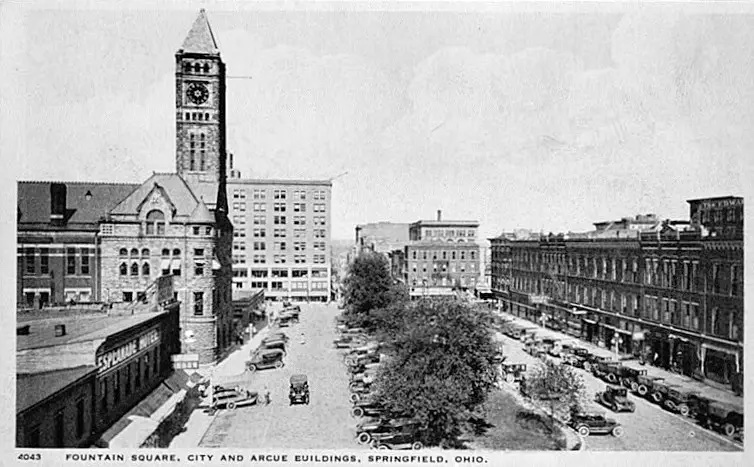
Located west of Columbus, Springfield developed with strong agricultural and manufacturing foundations. Originally shaped by flat terrain and regional farming traditions, the city gradually expanded its industrial capacity. Springfield became known as the “Champion City,” a nickname rooted in the Champion reaper and mower invented by William Whiteley, whose manufacturing transformed the city into a major agricultural equipment hub in the mid-1800s.
The Bauer Brothers Company, where Hecht previously worked, produced industrial processing machinery, including feed grinding mills, peanut and oil processing machinery, and wood manufacturing machinery — equipment that kept agricultural and industrial supply chains functioning.
Another major Springfield company that made significant contributions to the war effort was International Harvester. From October 1942 to January 1944, the Springfield facility produced 13,622 M4 Half Tracks, as well as thousands of military utility trucks, cargo trucks, and artillery prime movers. As the male workforce slowly diminished from enlistments, women increasingly assumed industrial positions within these local factories.
Citizen Participation
Home front participation extended beyond farming and factory labor. Like much of the United States at the time, citizens followed rationing policies, scrap collection programs, and blackout regulations mandated for national defense. Residents also supplemented food production through victory gardens. War bond drives and patriotic events fostered a sense of shared civic duty. Propaganda methods such as posters and rallies reinforced national unity and morale.
Despite economic changes, Springfield experienced few documented wartime tensions or political conflicts. The city maintained social stability while supporting the overall war effort.


Military Experience
William Arthur “Speedy” Hecht enlisted in the Marine Corps on April 9, 1942, in Cincinnati, Ohio. Shortly after enlistment, he qualified as a rifle sharpshooter.
Overseas
Hecht was assigned to the 19th Replacement Battalion beginning in May 1943, serving first in H&S Company and then in B Company, at the Replacement Training Center, Tutuila, American Samoa. Next, Hecht was transferred to the Defense Force Samoan Company in October 1943 in Apia, Western Samoa. He was finally transferred to Company B, 1st Battalion, 22nd Marines, as the regiment trained for amphibious warfare.
On January 4, 1944, Hecht’s unit embarked on USS Arthur Middleton at Pearl Harbor for final training rehearsals off Maui before sailing for the Marshall Islands on January 23. His deployment reflected the United States’ growing offensive strategy to push Japanese forces westward across the Pacific.
Battle of Eniwetok
In February 1944, Hecht fought in the Battle of Eniwetok, Marshall Islands, codenamed Operation Catchpole, which was a part of the broader American campaign to seize the Marshall Islands from Japanese control. Capturing Eniwetok would provide the Allies with a crucial airfield and harbor to support subsequent operations in the Central Pacific.
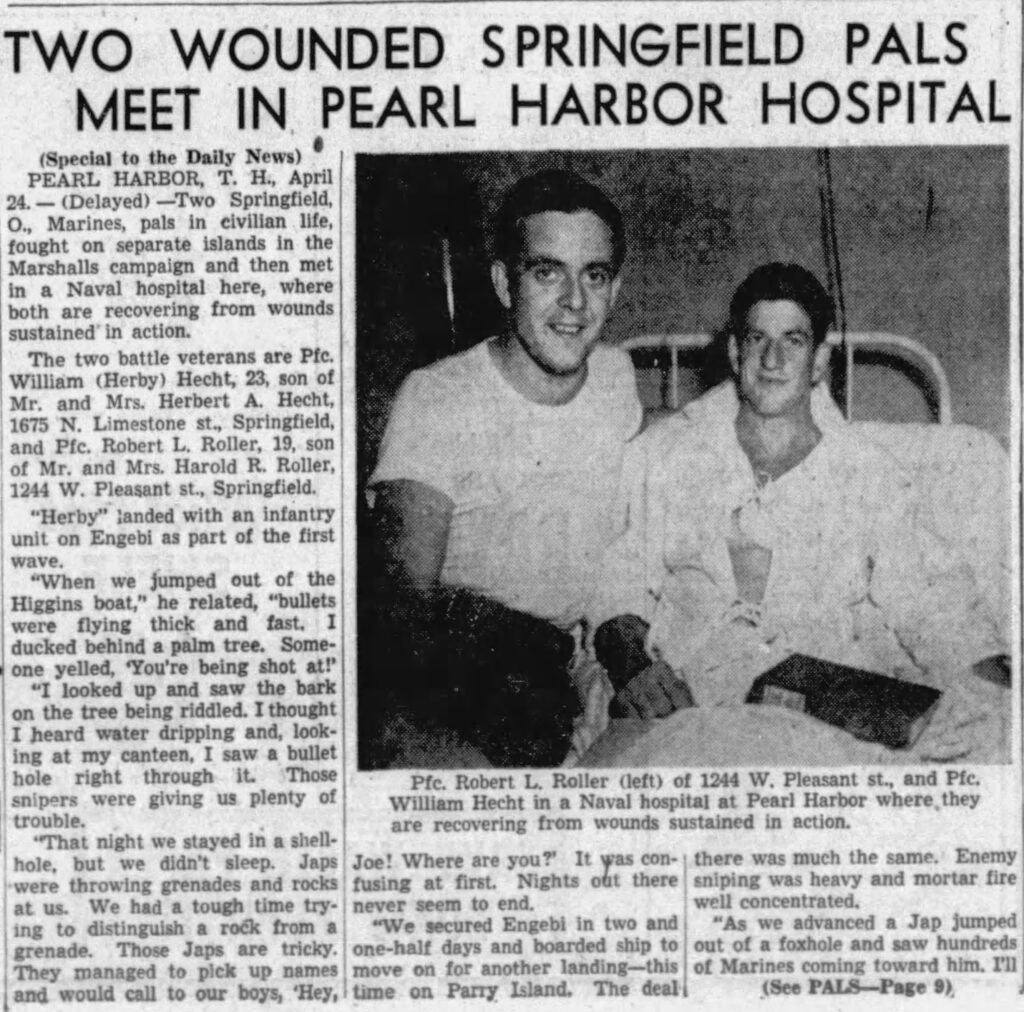
On February 18, Hecht was part of the first wave of Marines on Engebi, the first of three main islands in the Battle of Eniwetok. He recalled, “When we jumped out of the Higgins boat, bullets were flying thick and fast. I ducked behind a palm tree . . . I looked up and saw the bark on the tree being riddled.” He also recalled, “We stayed in a shellhole, but we didn’t sleep. Japs were throwing grenades and rocks at us. We had a tough time trying to distinguish a rock from a grenade . . . Nights out there never seemed to end.”
The unit secured the island that same day, and a few days later, they boarded the ship to the next island, Parry. It was there that Hecht was wounded.
Wounded
The 22nd Marines arrived on Parry on February 22. Hecht reported that he was firing on the enemy from inside a shellhole when he was shot through the chest. He made it back to the beach before he collapsed. From there, he was seen by a corpsman and then taken to a hospital ship.
While recovering, he met up with one of his friends from Springfield, Private First Class Robert L. Roller, who had been injured on Namur Island. The two were able to help each other through their recovery. While in the hospital, then-Admiral Chester W. Nimitz and others presented 347 individual awards to Eniwetok Veterans, among them Purple Heart recipients such as Hecht.
Hecht was discharged on October 19, 1945, at Camp Pendleton.

Veteran Experience
Following the war, on March 15, 1947, Hecht married Kathryn Marie Hildebrand in Dade County, Florida. Together, they had one daughter, Pamela. During this time, Hecht enrolled at the University of Miami and graduated in 1950.
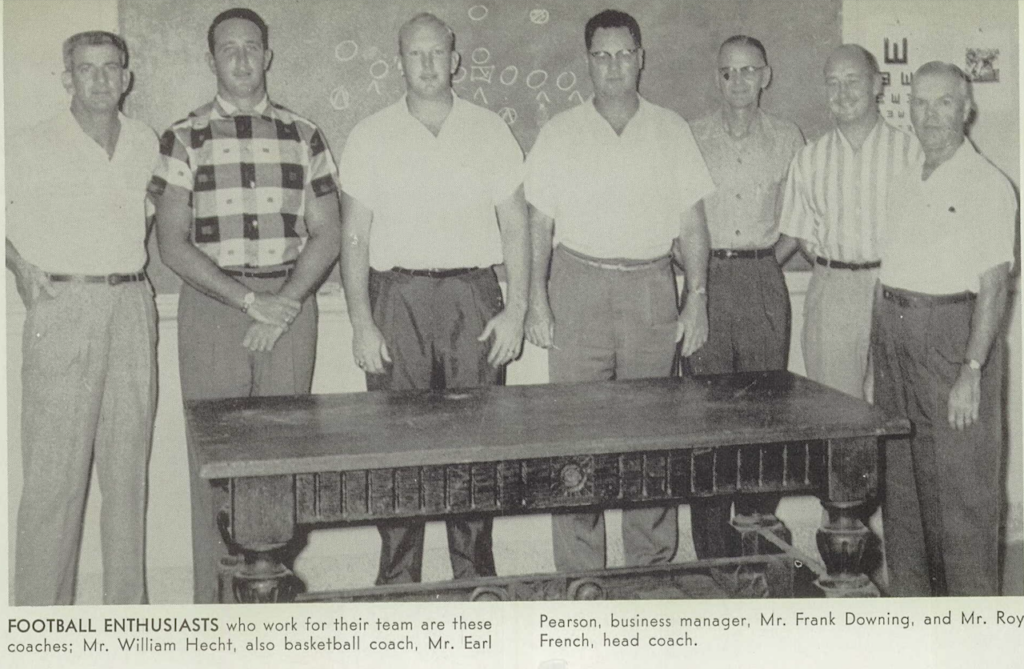
The Hechts established their home near Miami, Florida. Hecht initially worked as a baseball umpire in Dade County before entering the field of education. He joined the Miami school system and worked there for twenty-seven years as a teacher and coach. During that time, he coached football, basketball, and baseball at Miami Jackson High School. His professional life centered on teaching and athletic coaching within the public school system.
Outside of work, Hecht loved to play golf at the Country Club of Miami and maintained long-term friendships there. He remained connected to his community through education and athletics for decades.
Later in life, Hecht and his wife moved to Keller, Texas.

Commemoration
William Arthur “Speedy” Hecht passed away peacefully on May 2, 2012, in Dallas, Texas, at the age of 91. He was laid to rest at the Dallas-Fort Worth National Cemetery on May 18, 2012, with military honors.
Bibliography
Primary Sources
“44 Springfielders Receive Discharges From Armed Services.” Springfield News-Sun [Springfield, Ohio], October 26, 1945. Newspapers.com (824565301).
Florida. Dade County. 1950 U.S. Census. Digital Images. https://ancestry.com.
Fountain Square and Arcue (Arcade) Buildings. Postcard. Springfield, Ohio. https://www.historic-structures.com/oh/springfield/arcade_hotel6.php.
Hecht, William A. Ohio, U.S., Newspapers.com Marriage Index, 1800s–current. Digital Images. https://ancestry.com.
Hecht, William A. Ohio, U.S., World War II Jewish Servicemen Cards, 1942–1947. Digital Images. https://ancestry.com.
Hecht, William Arthur. World War II Draft Cards Young Men, 1940–1947. Digital Images. https://ancestry.com.
Hecht, William. Official Military Personnel File (partial), Department of the Navy. National Archives and Records Administration – St. Louis.
Ohio. Clark County. 1930 U.S. Census. Digital Images. https://ancestry.com.
Ohio. Clark County. 1940 U.S. Census. Digital Images. https://ancestry.com.
Portrait of a Marine Returning from an Assault on Enewetak [sic] Atoll, February 1944. Photograph. 1944. Collection of U.S. Official Coast Guard Images, The National WWII Museum. https://www.ww2online.org/image/portrait-marine-returning-assault-enewetak-atoll-february-1944.
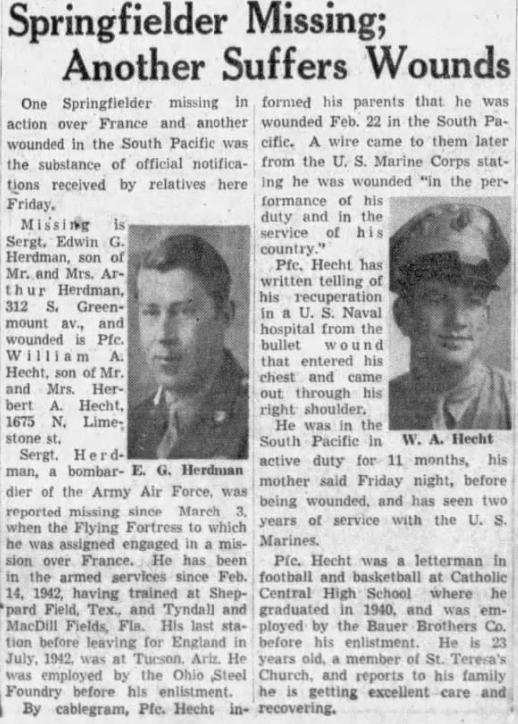
“Springfielder Missing; Another Suffers Wounds.” Springfield News-Sun [Springfield, Ohio], October 26, 1945. Newspapers.com (824565301).
“Tribute Paid to Local Workmen Who Earned Coveted Army-Navy ‘E’.” The Springfield Daily News [Springfield, Ohio], September 05, 1942. Newspapers.com (824552571).
“Two Wounded Springfield Pals Meet in Pearl Harbor Hospital.” Springfield News-Sun [Springfield, Ohio], April 27, 1944. Newspapers.com (824826169).
U.S. Coast Guard. USS Arthur Middleton (AP-55 / APA-25). Photograph. United States Coast Guard. https://www.history.uscg.mil/US-Coast-Guard-Photo-Gallery/igphoto/2002285127/.
William Hecht. U.S., School Yearbooks, 1900-2016. Digital Images. https://ancestry.com.
Secondary Sources
Goudy, Sherri. “Clark County and the War Propaganda Machine: How Posters Sold the War.” Clark County History. Accessed November 13, 2025. https://clarkcountyhistory.wordpress.com/2017/06/05/clark-county-and-the-war-propaganda-machine-how-posters-sold-the-war/.
“Hellish Battle in a Tropical Paradise.” Warfare History Network. July 20, 2022. https://warfarehistorynetwork.com/article/hellish-battle-in-a-tropical-paradise/.
Hickman, Kennedy. “World War II: Battle of Eniwetok.” ThoughtCo. Accessed November 24, 2025. https://www.thoughtco.com/battle-of-eniwetok-2360455.
“History of Springfield.” Wittenberg University. Accessed November 13, 2025. https://www.wittenberg.edu/about/history-springfield.
“International Harvester During World War II ‘The Strong Shall Be Free’ 74342.” Harvester Heritage. Accessed March 30, 2026. https://www.harvesterheritage.org/international-harvester-during-world-war.
“International Harvester in World War II.” The American Automobile Industry in World War Two. Accessed March 30, 2026. https://usautoindustryworldwartwo.com/internationalharvester.htm.
“National Park of American Samoa: World War II.” National Park Service. Accessed March 30, 2026. https://www.nps.gov/articles/samoawwii.htm.
“Operation Straw.” CodeNames. Accessed March 30, 2026. https://codenames.info/operation/straw/.
“Overview of Ohio.” Ohio History Connection. Accessed November 13, 2025. https://www.ohiohistory.org/wp-content/uploads/2022/01/rp-17-3.pdf.
“Springfield.” City Facts. Accessed November 13, 2025. https://www.city-facts.com/springfield-ohio/population.
“Springfield Historical Facts.” Ohio State University – Clark. Accessed November 13, 2025. https://clark.osu.edu/program-areas/agriculture-and-natural-resources/springfield-historical-facts.
“The Story of a Private.” The Miami Herald [Miami, Florida], May 5, 1985. Newspapers.com (631451226).
“William A. Hecht.” Veterans Legacy Memorial, National Cemetery Administration. Accessed November 13, 2025. https://www.vlm.cem.va.gov/WILLIAMAHECHT/B832A28.
“William A. ‘Speedy’ Hecht.” Find a Grave. Accessed November 13, 2025. https://www.findagrave.com/memorial/89878874/william-a-hecht.
“William Hecht.” Legacy Obituaries. Accessed December 11, 2025. https://www.legacy.com/us/obituaries/dfw/name/william-hecht-obituary?id=34768909.
This profile was funded by a grant from the United States Department of Veterans Affairs. The opinions, findings, and conclusions stated herein are those of the author and do not necessarily reflect those of the United States Department of Veterans Affairs.