
Corporal Willie Wesley Shankle
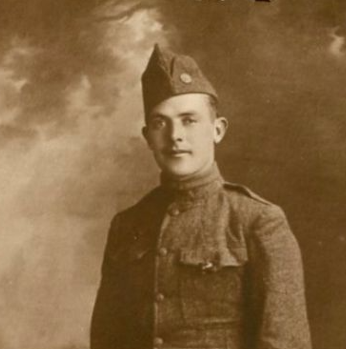
- Unit: Company L, 16th Infantry Regiment, 1st Infantry Division
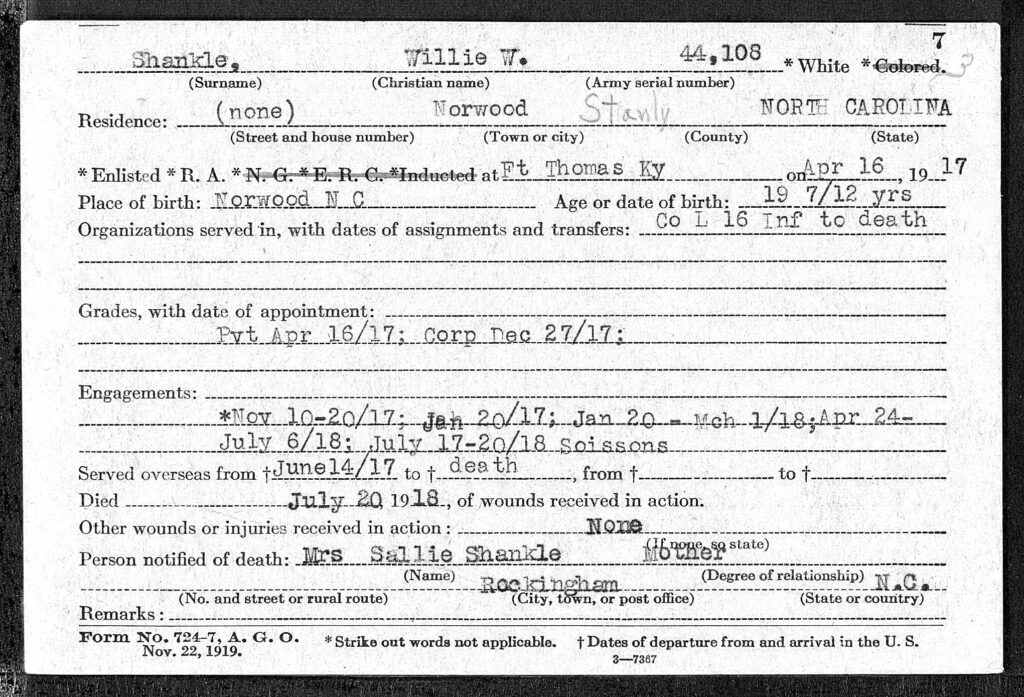
- Service Number: 44108
- Date of Birth: September 26, 1896
- Entered the Military: April 16, 1917
- Date of Death: July 20, 1918
- Hometown: Norwood, North Carolina
- Place of Death: Picardie, France
- Award(s): Purple Heart
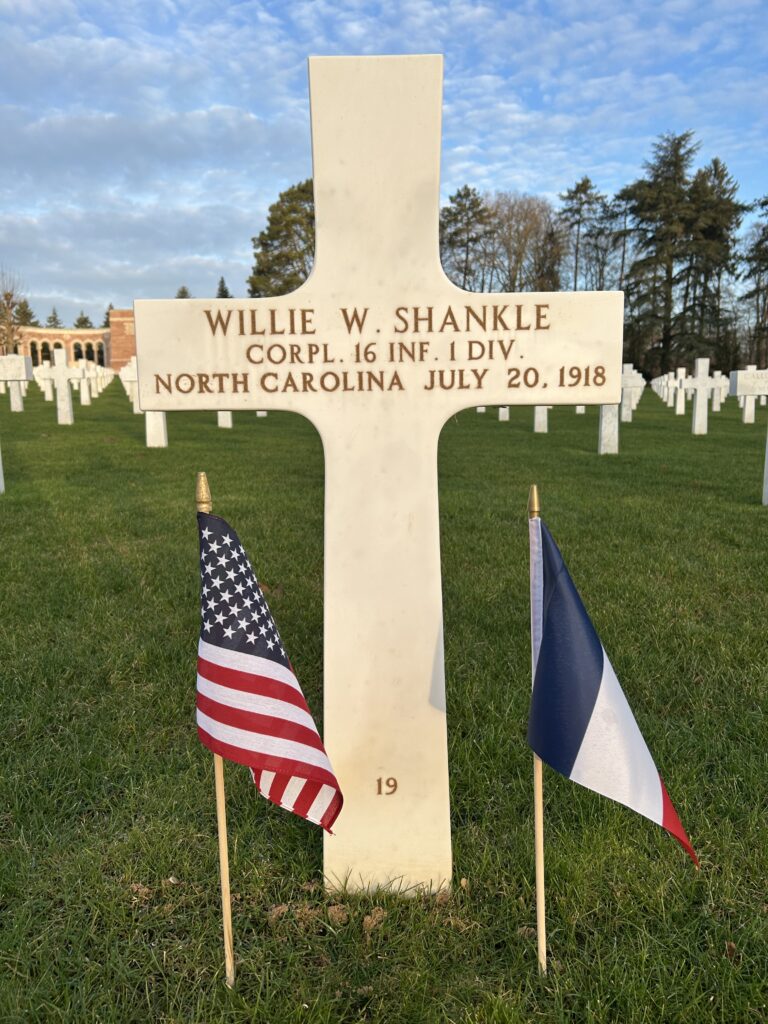
- Cemetery: Plot A, Row 18, Grave 20, Oise-Aisne American Cemetery, Seringes-et-Nesles, France. A memorial marker in Norwood Cemetery in Norwood, North Carolina.
Pine Spring Blended Academy, Holly Springs, North Carolina
2025/2026
Early Life
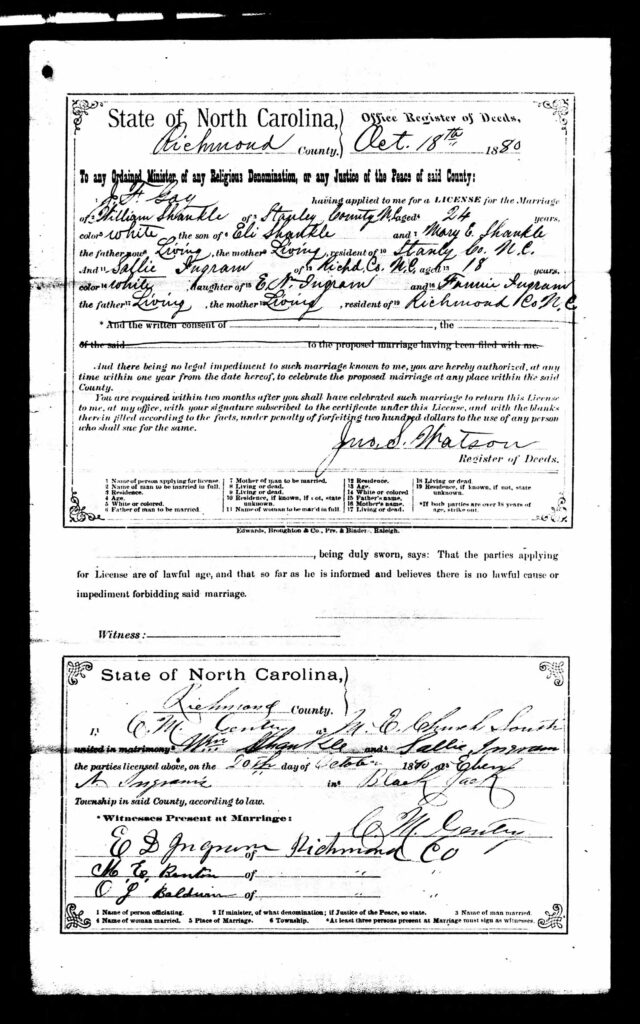
Willie Wesley Shankle was born on September 26, 1896, in Norwood, North Carolina, to parents William and Sara Shankle. His father passed away eight months before he was born, leaving his mother a widow with five children under the age of ten. After his passing, it is believed that the family moved back to the family home in Richmond County, North Carolina.
His family and farm life shaped his early years; the common crop in this region at the time was cotton, and it was likely what the family grew. Willie Shankle attended Rockingham schools through sixth grade and was described by his peers and teachers as a fun, humorous child.
By 1917, Shankle was living in Badin, North Carolina, and may have been employed by the Aluminum Company of America (Alcoa), which contributed to the U.S. war effort through aluminum production and the organization of War Bond sales to employees.
While traveling home to see his mother, he joined a group of friends who were on their way to Greensboro. The group of friends enlisted in the Army, supporting the United States’ entry into World War I. He left for the war, a healthy, six-foot-tall, 180-pound lad.


Homefront
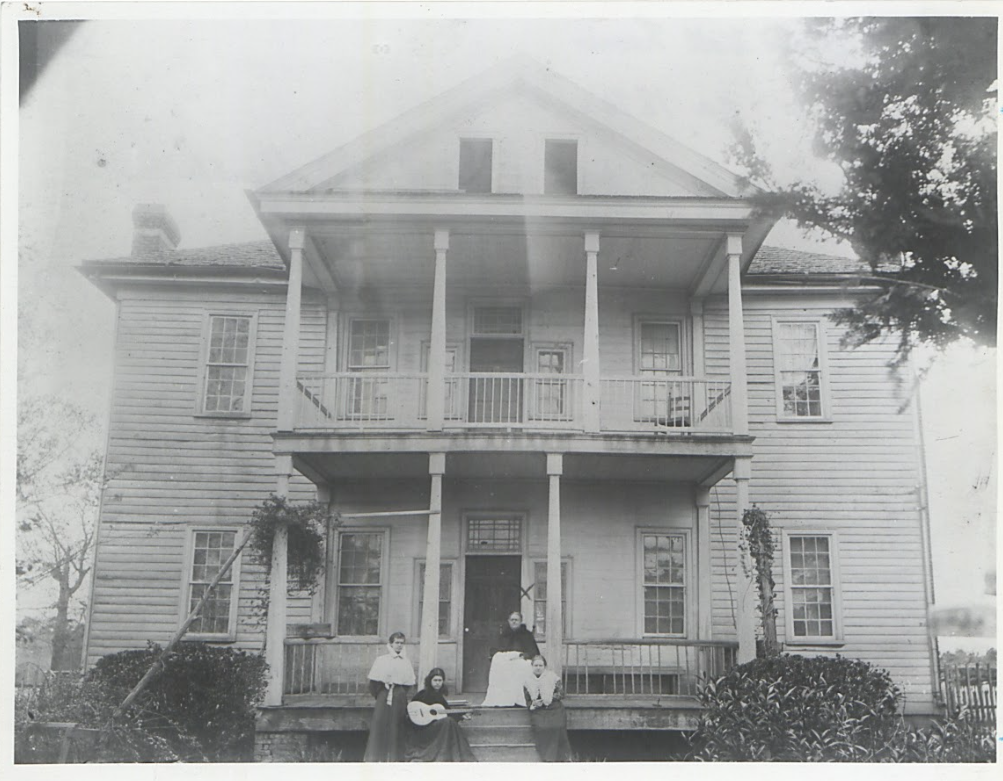
Willie Shankle lived in Norwood, North Carolina, a small rural farming community in central North Carolina, l near the South Carolina border. Established in the late 1880s, Norwood was primarily composed of families engaged in agriculture, especially tobacco and cotton farming, as well as lumber work and some textile-related labor.
During World War I, this region lacked major manufacturing plants or well-documented wartime industries, but it contributed through lumber mills and cotton production. There is little evidence that the town played a direct role in organized wartime food production or conservation efforts such as Victory Gardens, since most residents already maintained personal gardens as part of daily farm life.
From a financial perspective, North Carolina women worked with the Red Cross to raise funds for the war. Through letters sent home, Willie Shankle also supported the war by sending part of his earnings to his mother and purchasing Liberty Bonds.
Overall, despite the limited historical documentation, this part of North Carolina appears to have supported the war primarily through military enlistments rather than industrial output, reflecting its rural character and small population.
Military Experience
Willie Shankle came from a long line of soldiers. Both of his grandfathers, Eli Shankle and Eben Ingram, served in the Civil War. He enlisted in Greensboro, North Carolina, was transferred to Fort Thomas, Kentucky, on April 16, 1917, and finally to San Antonio, Texas. He began his service as a private in Company L, 16th Infantry Regiment, 1st Division.
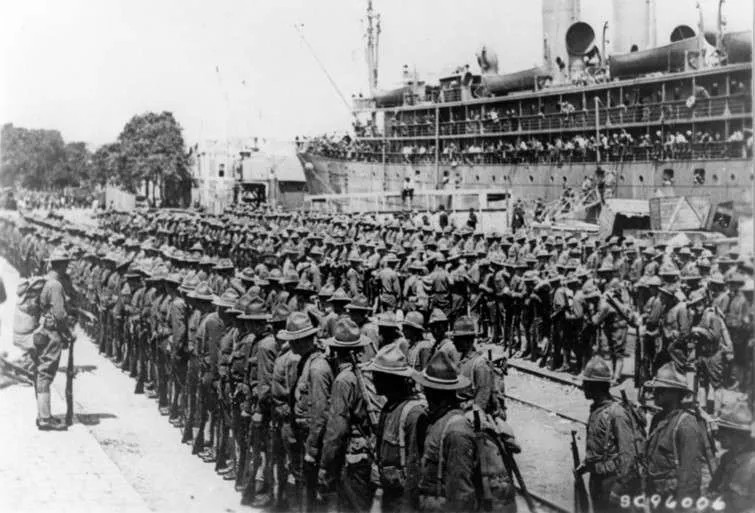
After being processed and receiving basic training, he departed the United States from Hoboken, New Jersey. His unit landed in St. Nazaire, France, in late June 1917 along with General John Pershing. Before heading off for training, he spent 72 hours in Paris with another soldier.
His unit trained in the Gondrecourt area alongside the French 47th Division, Chasseurs d’Alpines, before moving to the front lines. As a frontline infantry soldier, Shankle spent much of his time in trenches and active combat, participating in some of the earliest and most dangerous engagements involving American forces.
He was promoted to corporal on December 27, 1917, and fought in major battles including Bathlemont, Ansauville, Cantigny, and Coullemelle. At the Battle of Cantigny on May 28, 1918, the 16th Infantry Regiment led the first major American offensive of the war.
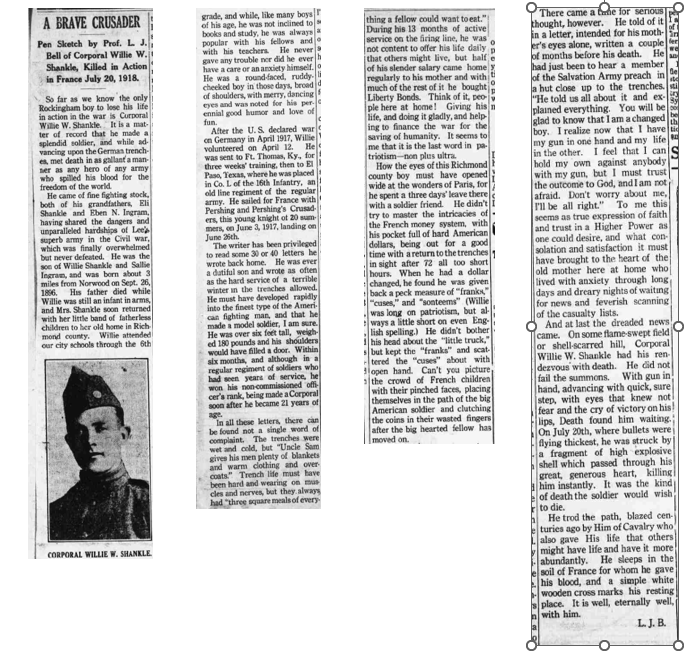
Throughout his time on the battlefield, Willie Shankle was known for writing letters home to his mother. In one such letter, he described hearing a sermon by a member of the Salvation Army. He wrote this to his mother, “He told us all about it and explained everything. You will be glad to know that I am a changed boy. I realize now that I have my gun in one hand and my life in the other. I feel that I can hold my own against anybody with my gun, but I must trust the outcome to God, and I am not afraid. Don’t worry about me, I will be alright.”
Commemoration
Willie Shankle served in the trenches at the Battle of Soisson on July 18, 1918. He was struck in his heart by a piece of high explosive shell and succumbed to his injuries two days later on July 20, 1918. It was one of the deadliest battles in the war. He was posthumously awarded the Silver Star for his bravery there.
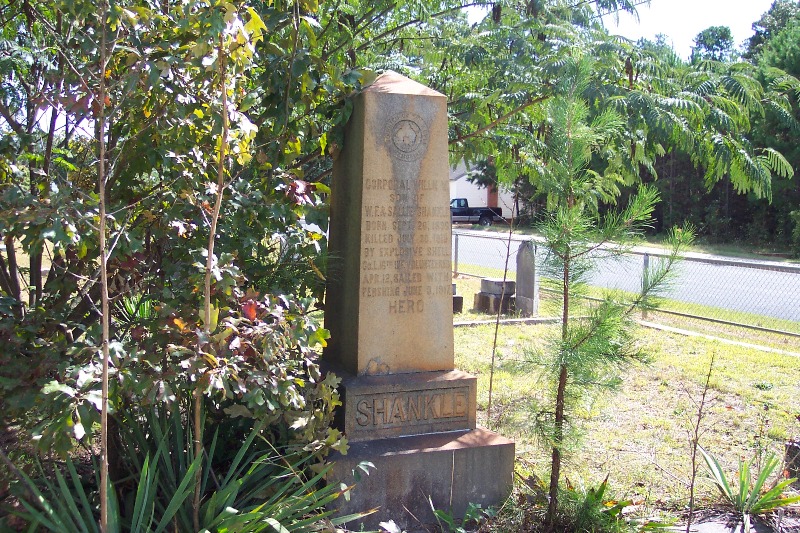
He is buried at the Oise-Aisne American Cemetery in Seringes-et-Nesles, France. His family also placed a memorial marker at Norwood Cemetery in Norwood, North Carolina, the same cemetery in which his father was buried.
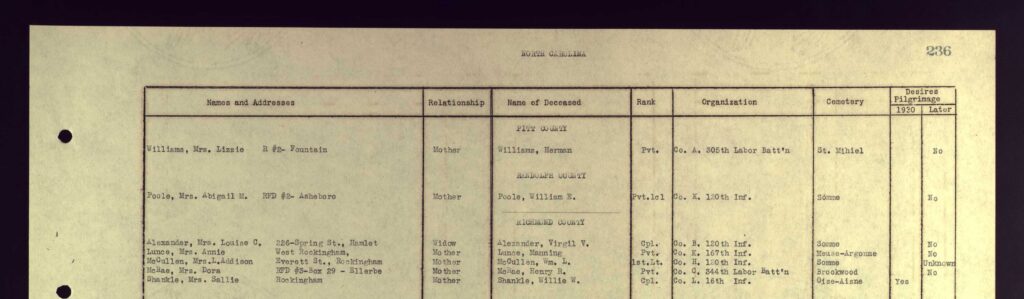
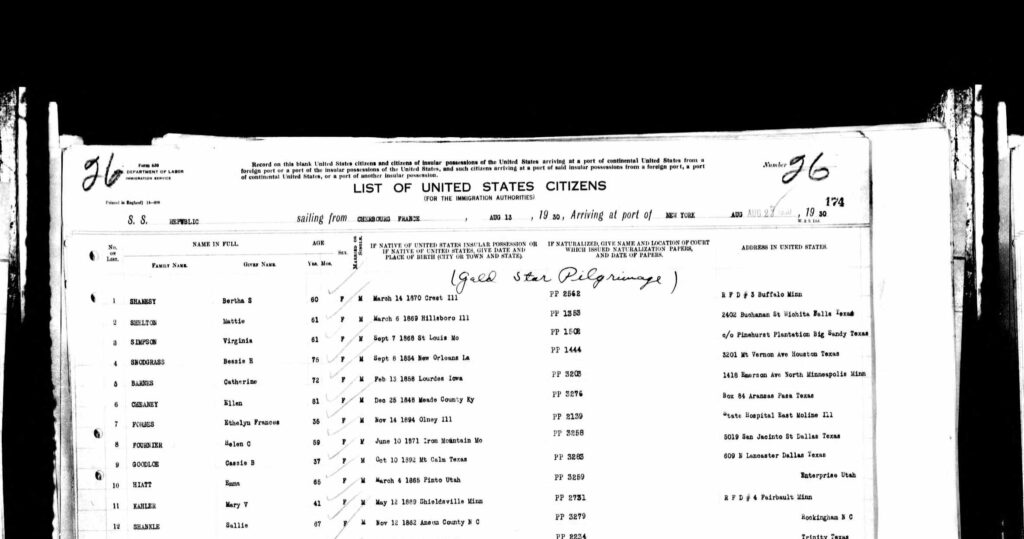
His mother, Sallie Shankle, later traveled to France as part of a Gold Star Mothers pilgrimage in 1930 to honor his sacrifice.
Corporal Willie Franklin Shankle is one of thousands of North Carolinians who never returned home from World War I. He left behind his family, his community, and a quiet rural life to serve his country on foreign soil, sacrificing everything in the name of duty and freedom.
Although his name may appear only in military records and distant memorials, Willie Shankle’s story reaches far beyond a single line of text. From the small farming towns of central North Carolina to the deadly trenches of France, he represents the courage of ordinary Americans placed in extraordinary circumstances. His service with the 16th Infantry Regiment placed him on the front lines of some of the war’s earliest and most dangerous battles, where he ultimately gave his life in 1918.
Willie Shankle’s life ended far from home, but his legacy lives on through his family, his service, and the freedoms preserved by his sacrifice. His story is a reminder that history is shaped not only by generals and leaders, but by young soldiers whose bravery changed the world.
Bibliography
Primary Sources
[Arrival at St. Nazaire]. Photograph. June 26, 1917. 16th Infantry Regiment Association. https://16thinfassn.org/wp-content/uploads/2017/01/Arrival-at-St-Nazaire.jpg.

“A Brave Crusader.” Rockingham Post-Dispatch, [Rockingham, NC], November 27, 1918. Library of Congress. https://www.loc.gov/resource/sn91068736/1918-11-27/ed-1/.
“Gold Star Mother Died June 13th.” Rockingham Post-Dispatch, [Rockingham, NC], June 19, 1946. Newspapers.com (67563516).
“Grave of Son To Be Visited.” The Charlotte Observer [Charlotte, NC], July 21, 1930. Newspapers.com (616842690).
North Carolina. Richmond County. 1910 U.S. Federal Census. Digital images. https://ancestry.com.
North Carolina. Stanly County. 1900 U.S. Federal Census. Digital images. https://ancestry.com.
Sallie Shankle. New York, U.S., Arriving Passenger and Crew Lists, 1820-1957. Digital images. https://ancestry.com.
Sallie Shankle. U.S., World War I Mothers’ Pilgrimage. Digital images. https://ancestry.com.
“Supreme Sacrifice.” Hickory Daily Record, August 22, 1918. https://ruralnchistory.blogspot.com/2018/08/corp-willie-shankle-killed-in-fighting.html.
William Wall House. Photograph. c.1870. Stanley County Museum, Digital NC. https://lib.digitalnc.org/record/5089.
Willie W. Shankle from Stanly County, N.C., wearing his U.S. Army uniform. . . . Photograph. C.1917-1918. World War I Papers, State Archives of North Carolina. https://www.vintag.es/2017/08/amazing-studio-portrait-photos-of-north.html.
Willie W. Shankle. North Carolina, World War I Service Cards, 1917-1919. Digital images. https://ancestry.com.
Willie W. Shankle from Stanly County, N.C., wearing his U.S. Army uniform. . . . Photograph. C.1917-1918. World War I Papers, State Archives of North Carolina. https://www.vintag.es/2017/08/amazing-studio-portrait-photos-of-north.html. Willie W. Shankle. U.S., Headstone and Internment Records for U.S. Military Cemeteries on Foreign Soil, 1942-1949. https://ancestry.com.
Secondary Sources
“The 16th Infantry Regiment, United States Army.” American Battlefield Trust. Updated July 7, 2017. Accessed February 9, 2026. https://www.battlefields.org/learn/articles/16th-infantry-regiment-united-states-army.
“Center – Explore Norwood’s History.” Norwood.Accessed February 9, 2026. https://norwoodgov.com/center-explore-norwoods-history/.
“Corp. Willie Wesley Shankle.” Find a Grave. Updated August 8, 2010. Accessed February 9, 2026. https://www.findagrave.com/memorial/56640282/willie-wesley-shankle.
Glass, Brent D. “Cotton Mills.” NCpedia, State Library of NC. Updated 2006. Accessed February 9, 2026. https://www.ncpedia.org/cotton-mills.
“History.” City of Alcoa. Accessed February 9, 2026. https://www.cityofalcoa-tn.gov/580/History.
“History of the 16th Infantry Regiment.” 16th Infantry Regiment Association. Accessed February 9, 2026. https://16thinfassn.org/history/regimental-history/.
Peek, Matthew M. “North Carolina’s WWI Collector of War Records.” Blog. March 13, 2017. North Carolina Department of Natural & Cultural Resources. https://www.dncr.nc.gov/blog/2017/03/13/north-carolinas-wwi-collector-war-records.
“Shankle Willie Wesley.” American War Memorials Overseas, Inc. Accessed February 1, 2026. https://www.uswarmemorials.org/html/people_details.php?PeopleID=9528.
Stroup, Jane Shaw. “The Textile Industry in North Carolina.” North Carolina History Project. Updated 2026. Accessed February 9, 2026. https://northcarolinahistory.org/encyclopedia/the-textile-industry-in-north-carolina/.
“William Franklin Shankle.” Find a Grave. Updated February 26, 2010. Accessed February 9, 2026. https://www.findagrave.com/memorial/48832967/william_franklin-shankle.
“Willie W. Shankle.” American Battle Monuments Commission. Accessed February 9, 2026. https://weremember.abmc.gov/s?q=*&type=16&criteria=title%3Dshankle&b=0&a=c&v=G.
“Willie W. Shankle.” Hall of Valor. Accessed February 9, 2026. https://valor.militarytimes.com/recipient/recipient-83372/.
“Willie W. Shankle.” Veterans Legacy Memorial, National Cemetery Administration. Accessed February 9, 2026. https://www.vlm.cem.va.gov/WillieWShankle/172A5.
“Willie Wesley Shankle.” Find a Grave. Updated April 23, 2022. Accessed February 9, 2026. https://www.findagrave.com/memorial/239143596/willie-wesley-shankle.
This profile was researched and created through the Researching Silent Heroes program, sponsored by the American Battle Monuments Commission.